
The leaks, gaps and risks a routine check walks straight past, and how PKC finds them.
| TL;DR SummaryPlenty of firms find their financial slips and process leaks only once the bill arrives. Sharp audit and assurance services spot those troubles while they are still small. PKC blends the legal weight of a statutory audit with hands-on process audit services that chase down lost revenue, shaky controls and fraud exposure. You walk away with tidier books, leaner operations and no eleventh-hour panic. Curious about a free opening-month audit? Speak with PKC. |
| Audit and assurance services check your financial records and operating controls on their own merit, confirming the numbers are correct, lawful and dependable. A statutory audit satisfies the reporting duty written into the Companies Act. Process audit services study how your everyday workflows really behave, so you can seal leaks, halt fraud and repair the control gaps an ordinary review skips. |
The Audit That Passed, Just Before Everything Fell Apart
Imagine the scene. A fast-rising company clears every checkbox. The ledgers look spotless. The yearly audit gets signed. Everybody exhales and moves on. Then a tax notice drops on the desk. Or a vendor everyone trusted turns out to have padded invoices for two years straight. Or a buyer abandons the deal halfway through because the diligence dug up things no one had flagged.
I have watched this story repeat itself far too often. And the sting never changes. The audit told no lies. It simply never looked deep enough.
That blind spot is the whole reason careful audit and assurance services count. Not the rubber-stamp variety. The kind that actually digs in. So here is a fair question to sit with. When did your last auditor surprise you with something genuinely useful? Across this guide you will see what these services truly cover, why standard checks skip the costliest problems, and how a sharper take on statutory audit and process audit services guards both your cash and your calm. PKC has run more than 1000 audits each year for over 1500 clients across 37 years, so every pattern here comes from the field, not a textbook.
What Audit and Assurance Services Really Mean
Let us strip this down. So where does one end and the other begin?
An audit confirms whether your figures are telling the truth. Assurance reaches further. It earns confidence in the bigger picture, your controls, your processes, your reporting. Knit them together and audit and assurance services hand your stakeholders a solid reason to believe what your business claims about itself.
Three pillars carry most of the weight for a company on the rise:
- Statutory audit. The legally required look at your financial statements.
- Internal and process audit. A risk-led study of how your operations and controls behave day to day.
- Assurance engagements. Independent reviews that give comfort on focused areas like MIS reporting or compliance.
PKC holds a handy position here. It is a chartered accountant led firm wired to act rather than merely watch. Browse the full range of audit and assurance services if you like, but the gist is this. PKC chases findings you can use, not a doorstop report nobody opens.
Why Standard Checks Skip the Things That Hurt Most
Time for the awkward bit, because this is where the money quietly walks out the door.
Many audits exist to confirm compliance, not to hunt for trouble. They sample. They tick. They sign. And the data echoes the concern. Assessment trend reports point to more than 60 percent of audit defaults springing from a mistaken grasp of what the audit even had to cover, not from outright fraud.
So the genuine risks slide by. Revenue seeps away. Controls stay loose. Minor frauds grow up. And nobody clocks it until the damage surfaces on a balance sheet or a tax order.
Common Blind Spots in a Standard Audit
- Inter-company and vendor entries that never get reconciled.
- Manual journal postings that shift numbers without a clear trail.
- Loose vendor onboarding that invites overbilling.
- GST and TDS mismatches that summon notices down the line.
- Stock counts that never quite agree with the books.
PKC treats the audit as a search, not a formality. Its broader risk advisory thinking is built around exactly that habit.
Statutory Audit: Honouring the Law Without Cutting Corners
A statutory audit is the legally mandated review of your financial statements under the Companies Act, 2013. And this trips up many founders. Every private limited company in India needs one. No turnover figure lets you wriggle out. Even a company earning nothing still files audited accounts.
Tax audit is a separate animal and runs under Section 44AB of the Income Tax Act. It applies once business turnover passes ₹1 crore, or ₹10 crore where cash receipts and payments stay below 5 percent of the total. For professionals, the mark sits at ₹50 lakh. For FY 2025 to 26, the CBDT extended the tax audit filing date to 31 October. From 1 April 2026, ICAI also limits every chartered accountant to 60 tax audits a year, so hiring a firm with real capacity matters more than ever.
| Mind the penaltiesSkip your tax audit and Section 271B stings at 0.5 percent of turnover, capped at ₹1,50,000. Neglect the statutory side and Section 147 can fine the company up to ₹5 lakh, with directors penalised on top. File AOC-4 or MGT-7 late and ₹100 stacks up each day. A clean statutory audit finished on time costs a fraction of any of that. |
Who Needs a Statutory Audit in India
- Every private limited company, public company and OPC, whatever the turnover.
- LLPs once turnover tops ₹40 lakh or capital contribution tops ₹25 lakh.
- Businesses crossing the Section 44AB tax audit limits noted above.
PKC runs the whole filing cycle, from naming an auditor within 30 days of incorporation to AOC-4 and MGT-7 after the AGM. Its financial audit team pushes past the legal floor to flag risks and savings along the way.
| Image Brief 2Generation prompt: Clean infographic style illustration comparing statutory audit and process audit as two pillars supporting a growing business building, blue and white palette, simple icons, flat design. Filename: statutory-audit-vs-process-audit-services-pkc.jpg ALT tag: Statutory audit and process audit services compared as two pillars of business assurance Placement: Place at the start of the comparison section below, so readers see the visual contrast before the table. |
Process Audit Services: Finding the Money You Are Quietly Losing
If statutory audit shields you from the law, process audit services shield you from yourself. This is the high-return work. A process audit inspects how your business truly operates, from procure to pay (buying and settling bills) through order to cash (selling and collecting), across payroll and inventory, then pinpoints where money and control drain away.
Take one PKC client juggling 40 stores. Sheer scale had stripped them of any real grip on expenses, and costs crept up store by store. A process review put them back in command of spending. Elsewhere, one client trimmed accounting costs by 70 percent, and another dodged a ₹50 lakh GST liability while also cutting ₹4.5 lakh a year from finance costs. That is what process audit services deliver when they bite.

What a Process Audit Actually Examines
- Procurement and vendor controls, to choke off overbilling and leakage.
- Order to cash, so every rupee of revenue gets billed and collected.
- Inventory and stock movement, from supplier dispatch to shop floor.
- Payroll and reimbursement, to wipe out manual error and misuse.
- Internal financial controls, mapped against a risk control matrix (RCM).
See how PKC frames this on its process audit page, and pair it with internal audit services when you want steady control monitoring rather than a single snapshot.
How These Services Fix Real Business Problems
Let me line up the pain against the cure, since that is what truly matters to you.
- Fundraising stalls. Investors open messy books and pause. A clean audit makes you diligence-ready before they even ask.
- Fraud stays hidden. A process audit drags the weak controls behind it into the light.
- Costs creep upward. Leakage reviews claw back money you never knew was slipping out.
- Tax notices arrive. A rigorous statutory audit catches GST and TDS mismatches early.
- Deals collapse. Audit-ready records keep buyers in their seats.
PKC backs this with proprietary audit automation tools and more than 20 qualified chartered accountants, so the work moves fast and the findings hold up under scrutiny. The payoff stacks up plainly: penalties avoided, leaked money recovered, investor trust earned, year-round readiness, sharper decisions from clean data, and far thinner odds of fraud. Browse the case studies on the audit page for the full sweep.
Statutory Audit vs Process Audit: Which One Do You Need?
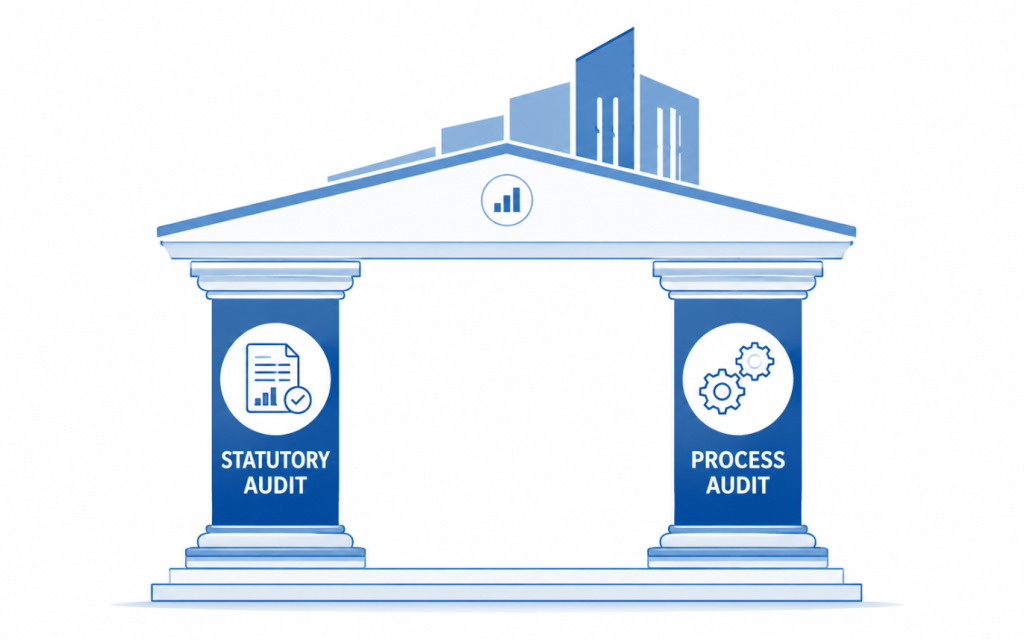
Quick answer. Most growing businesses need both working side by side. So how do they actually differ? Here it is.
| Factor | Statutory Audit | Process Audit Services |
|---|---|---|
| Purpose | Verify financial statements | Sharpen how operations run |
| Trigger | Companies Act, every year | Risk, cost or growth pressure |
| Legal requirement | Mandatory for all companies | Optional but high value |
| Frequency | Annual | As needed or recurring |
| Main benefit | Compliance and stakeholder trust | Leakage recovery and control |
Still weighing it up? PKC’s guide to the best audit firms unpacks statutory, internal and forensic specialisms in everyday language.
What Sets PKC’s Approach Apart
Many firms talk a smooth game on audit. Fewer actually follow through. PKC is built to execute, which makes it a grounded alternative to the Big Four for growing Indian businesses. You get partner-level attention, deep sector grounding across retail, manufacturing and energy, and reports written in language you can put to work.
The figures fill in the rest. 37 years in practice. More than 1500 clients. Over 1000 audits a year. And a clear bias toward usable insight over box-ticking. As one long-standing client described it, the internal audit was structured and the quality of service was excellent. More on why businesses pick PKC.
How to Choose the Right Audit and Assurance Partner
Before you sign with anyone, run this short checklist.
- Ask how they uncover issues, not just how they tick boxes.
- Check their capacity against the fresh ICAI 60-audit cap.
- Confirm they cover both statutory and process work.
- Look for sector experience near your own industry.
- Read a sample report. Is it usable, or just thick?
Common Mistakes to Avoid
- Hiring on price alone, then paying for it later.
- Leaving auditor appointment to the last minute.
- Treating the audit as paperwork instead of protection.
Get those wrong and the cheap audit quietly becomes the expensive one.
Stop Auditing to Tick Boxes. Start Auditing to Win.
The right audit and assurance services turn a compliance cost into a genuine edge. A sharp statutory audit keeps you clean and penalty-free. Strong process audit services hand back money and control you never realised you were losing. And catching trouble early always beats explaining it later.
PKC has done this for more than 1500 businesses, and the first month of audit costs you nothing. Ready to find what your last audit missed? Book your free audit assessment with PKC, or dig into more guides on the PKC blog.
Frequently Asked Questions
What is the difference between audit and assurance services?
An audit confirms your financial statements are accurate. Assurance is wider and builds confidence in the surrounding information, such as controls, processes and reporting. Side by side, they give stakeholders a reason to trust your business.
Is statutory audit mandatory for every company in India?
Yes. Each private limited company, public company and OPC requires a statutory audit under the Companies Act, 2013, no matter the turnover. Even a company with no revenue must still file audited accounts.
What are process audit services and how do they help?
Process audit services review how your operations genuinely run, across buying, selling, payroll and inventory. They expose lost revenue, weak controls and fraud risk, then suggest fixes you can act on right away.
How often should a business run a process audit?
No law sets a frequency. Run a process audit when you scale, feel cost pressure, or suspect leakage. Many businesses schedule one yearly alongside the statutory audit.
What is the penalty for missing a tax audit in India?
Under Section 271B, the penalty is 0.5 percent of turnover, capped at ₹1,50,000. Relief is possible under Section 273B for honest reasons. For FY 2025 to 26 the CBDT extended the filing date to 31 October.
How does PKC handle audit and assurance engagements?
PKC opens with a close review of your current processes, then designs and rolls out controls suited to you, and stays on for ongoing support. The emphasis stays on findings you can use rather than box-ticking.